Recovery-aware training: what deload actually means
Unlock smarter training. Learn what a deload truly means, how recovery, readiness, and adaptation drive progress, and why Ascend Fitness uses your data to build a truly responsive plan.
In this article
What a Deload Isn't (and What It Is)
Most people get deload wrong. They hear "deload" and think "week off." A holiday from the gym. An excuse to eat pizza and binge-watch. Let's be direct: that's not a deload; that's a break. While breaks have their place, a true deload is a precise, strategic tool in your training arsenal. It's not about stopping; it's about intelligent reduction.
At Ascend Fitness, our journey up the mountain is continuous. You don't take a week-long helicopter ride down to base camp every few weeks. Instead, you navigate varied terrain, sometimes pushing hard, sometimes conserving energy, always moving forward. A deload is like navigating a flatter, less strenuous section of the trail – it allows your body to consolidate gains, repair, and prepare for the next ascent without losing momentum. Ignoring this fundamental principle is a surefire way to hit plateaus, invite injury, and ultimately, fall short of your summit.
The Pillars of Progress: Recovery, Readiness, and Adaptation
To understand deloading, we must first define the three interconnected pillars that govern all effective training:
* Recovery: This is the physiological process of returning your body to a baseline state after exertion. It's about repairing muscle tissue, replenishing energy stores, rebalancing hormones, and reducing inflammation. Recovery isn't passive; it's an active, essential biological function that requires adequate nutrition, hydration, and rest. Without proper recovery, your body simply cannot rebuild stronger. * Readiness: This refers to your body's current capacity to perform and adapt to further training stress. It's a snapshot of your physical and mental state at any given moment, reflecting how well you've recovered and how prepared you are for the next challenge. High readiness means your body is primed to absorb and benefit from a tough workout. Low readiness means you're operating in a deficit, and additional stress could be detrimental. * Adaptation: This is the ultimate goal of training. It's the process by which your body responds to stress by becoming stronger, faster, more resilient, or more efficient. You train, you recover, and in response, your body adapts. Without sufficient recovery and optimal readiness, adaptation is compromised, and your efforts in the gym or on the trail become largely ineffective.
These three elements form a crucial feedback loop. You apply stress (training), your body recovers, and if that recovery is sufficient, your readiness improves, leading to positive adaptation. A deload, properly executed, optimises this loop, ensuring you're always adapting, never just grinding.
Your True Signal: HRV, RHR, and Sleep
Forget guessing. Your body is constantly sending signals about its recovery and readiness. The most potent and reliable signals come from a combination of Heart Rate Variability (HRV), Resting Heart Rate (RHR), and sleep quality/quantity. When combined, these metrics offer a comprehensive, actionable picture of your physiological state.
* Heart Rate Variability (HRV): This measures the variation in time between your heartbeats. Higher HRV generally indicates a more relaxed, recovered state where your parasympathetic nervous system (rest and digest) is dominant. Lower HRV often suggests stress, fatigue, or overtraining, with your sympathetic nervous system (fight or flight) taking over. It's a powerful proxy for nervous system balance. * Resting Heart Rate (RHR): Your RHR is the number of times your heart beats per minute while at rest. A consistently elevated RHR, especially when compared to your personal baseline, often indicates fatigue, illness, or insufficient recovery. A stable or slightly decreasing RHR suggests good recovery and improved cardiovascular fitness. * Sleep Quality and Quantity: This is non-negotiable. Deep sleep is when most of your physical repair and hormone regulation occurs. REM sleep is vital for mental restoration. Insufficient or poor-quality sleep directly impairs recovery, elevates stress hormones, and diminishes cognitive function, directly impacting your readiness for training.
The American College of Sports Medicine (ACSM) consistently highlights the importance of monitoring physiological markers for optimal training prescription and injury prevention (ACSM 2018). While individual metrics are informative, it's their combined trend that truly speaks volumes. A dip in HRV, coupled with an elevated RHR and poor sleep, isn't just a flag; it's a blaring siren telling you to adjust.
Why Your Wearable Isn't Your Coach
Devices like Whoop, Oura, and Garmin are fantastic tools. They collect invaluable data on your HRV, RHR, and sleep. They can tell you, with impressive accuracy, if your readiness score is low. They excel at *flagging* potential issues. However, here's the critical distinction: they don't fix your training.
A wearable will tell you, "Your recovery is poor today. Take it easy." But what does "take it easy" actually mean? Does it mean skip your workout entirely? Reduce the weight? Do more cardio? What about the context of your overall training plan? This is where generic advice falls short. These devices are sophisticated thermometers; they tell you if you have a fever, but they don't prescribe the medicine or adjust your diet.
| Feature | Generic Wearable Insights | Ascend's Actionable Plan |
|---|---|---|
| Data Interpretation | Flags low readiness, high strain | Interprets data against your unique plan |
| Actionable Advice | "Take it easy," "prioritise sleep" | Modifies specific workout volume/intensity |
| Training Context | Isolated daily score | Integrated into multi-week periodisation |
| Plan Adjustment | None, user decides | Automatic, intelligent program adaptation |
Ascend's Approach: Data-Driven Training Cycles
At Ascend, we believe in smart, sustainable progression. Our training programmes are built on principles of periodisation and progressive overload, much like those advocated by renowned coaches such as Steve House and Scott Johnston of Mountain Tactical Institute for high-performance mountain athletes (House & Johnston 2014). This means we structure your training into cycles, carefully managing volume and intensity to maximise adaptation and minimise risk.
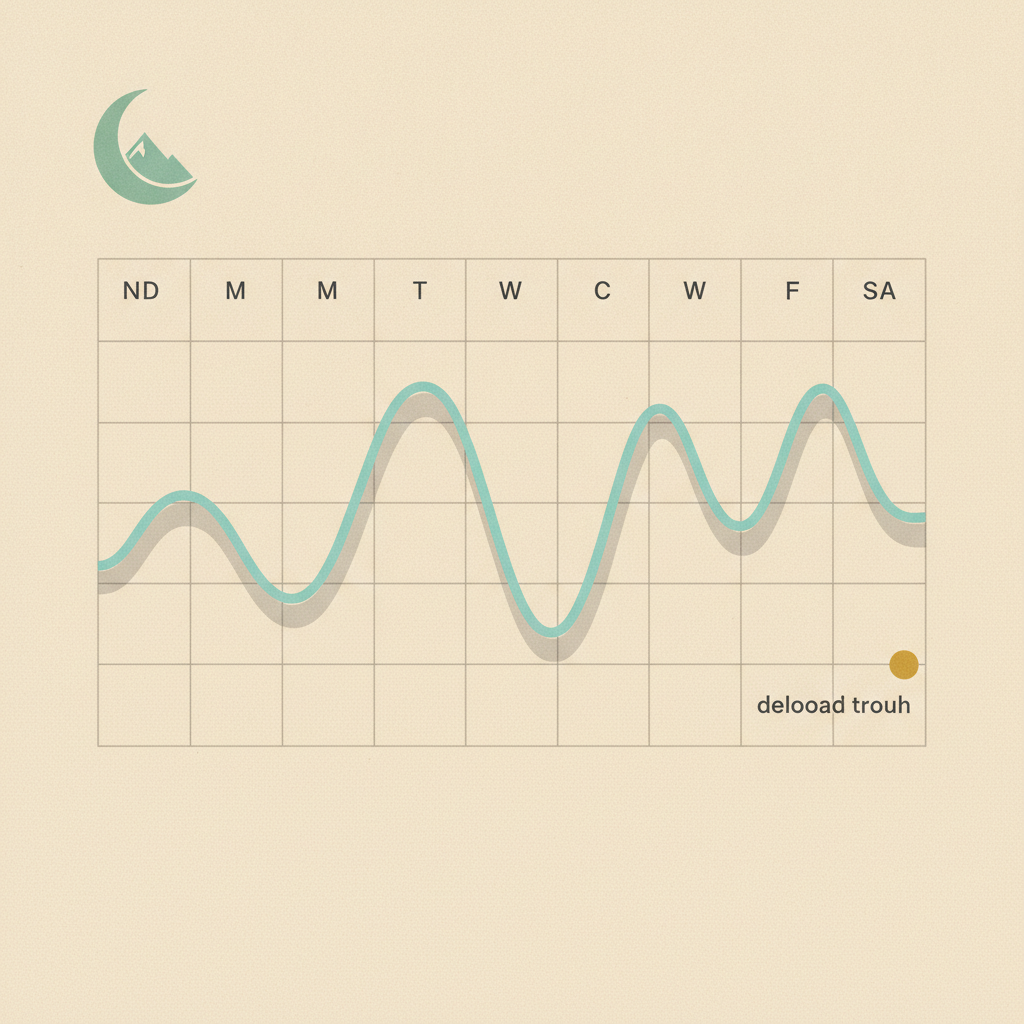
A core component of this is our adaptive volume cycle, typically moving through phases like 100%, 70%, and 50% of your peak training volume and intensity.
* 100% Weeks: These are your peak training weeks, where you push volume and intensity to stimulate significant adaptation. You're making strong gains, climbing hard. * 70% Weeks: These are often active recovery or slightly reduced volume weeks, allowing for continued training stimulus but with less accumulated fatigue. Think of it as a slightly less steep section of the trail, allowing you to maintain pace without burning out. * 50% Weeks (The True Deload): This is where strategic reduction truly comes into play. A 50% deload week isn't a week off; it's a week where your volume and intensity are significantly cut back – roughly half of your peak – while still engaging in activity. The goal is to maintain movement patterns, promote blood flow, and provide just enough stimulus to keep your body primed, without adding significant stress. This allows for supercompensation, where your body over-recovers, becoming stronger than before the deload.
Here's how Ascend takes this to the next level: we integrate your real-time readiness data (HRV, RHR, sleep) directly into this cycle. If our system detects consistently low readiness signals – a prolonged dip in HRV, an elevated RHR, or poor sleep trends – it doesn't just tell you to "take it easy." It might:
* Proactively shift a scheduled 100% week to a 70% or even 50% week. Instead of hitting a wall, you smoothly transition to a recovery phase. * Modify individual workout parameters within a week. Perhaps your planned heavy lifts are swapped for lighter, higher-rep sets, or a long endurance session is shortened. * Suggest specific recovery activities that align with your current physiological state, such as low-intensity mobility work or extra sleep.
This isn't about arbitrary changes; it's about making intelligent, data-informed decisions that respect your body's current capacity. You're still making progress, but you're doing it smarter, preventing overtraining before it takes hold.
Practical Application: Integrating Readiness into Your Ascend Journey
When you open the Ascend app, your personalized plan isn't static. It's a living, breathing guide up your chosen mountain. The insights from your connected devices – whether it's an Apple Watch, a Garmin, or manual input – feed directly into our adaptive algorithm.
If your readiness metrics indicate you're performing well and recovering optimally, Ascend will keep you on track with progressive overload, ensuring you're challenged appropriately to continue adapting and gaining elevation. If, however, your data suggests a dip in readiness, Ascend's system will intelligently adjust. You might see:
* Modified Workout Prescriptions: Lighter weights, fewer reps, shorter durations, or a shift in exercise type to reduce systemic load. * Increased Recovery Focus: Prompts for active recovery sessions, foam rolling, stretching, or simply encouraging more rest days. * A Strategic Deload: Our system might automatically schedule a 50% volume week earlier than planned, ensuring you consolidate gains and avoid burnout.
This isn't about avoiding hard work; it's about making hard work sustainable and effective. It's about listening to your body, amplified by smart data analysis, and ensuring every step you take up the mountain is purposeful and productive.
Ascend the Smart Way
Recovery-aware training isn't a luxury; it's a necessity for long-term progress and injury prevention. Understanding what a deload truly means – a strategic reduction, not an absence of training – is fundamental. By integrating the powerful signals from your HRV, RHR, and sleep with intelligent, adaptive programming, Ascend Fitness empowers you to train smarter, recover better, and achieve your peak performance without the guesswork. Stop just collecting data; start acting on it.
Ready to climb higher, smarter, and with genuine, data-driven support?
Sam Wilson
Solo founder of Ascend Fitness. Building a gamified fitness tracker in Auckland, NZ. Lifts, runs, writes about both.
Ready to start climbing?
Beta climbers get TestFlight access, 14-day Ascend Club free trial, and a permanent founder discount on annual.
Join the waitlist