Masters deload cadence: why every 3rd week (not every 4th)
Are you 50+ and lifting heavy? Your deload strategy needs an upgrade. Discover why a 2-week load, 1-week deload cycle is crucial for masters athletes to boost recovery and gains. Ascend Fitness shows
In this article
For years, the conventional wisdom for strength training has been a 3-weeks-on, 1-week-off deload cycle. For lifters under 30, this cadence often works remarkably well, providing enough stimulus for adaptation followed by adequate recovery to come back stronger. But if you've crossed the half-century mark, it's time to challenge that dogma. For masters athletes, a 2-weeks-on, 1-week-off deload cadence isn't just an option; it's a non-negotiable for sustained progress and injury prevention.
The Unspoken Truth: Ageing and Recovery
Your body, despite your best efforts, changes with age. This isn't a judgment; it's biological reality. What works for a 25-year-old powerlifter simply doesn't apply directly to a 55-year-old who's just as committed to the iron. The primary reason? Your connective tissues—tendons, ligaments, and cartilage—recover at a different rate. While your muscles might feel ready for another heavy session, the supporting structures are often still playing catch-up.
Pushing through this deficit is a recipe for stalled progress, chronic aches, and, ultimately, injury. The goal isn't just to lift heavy; it's to lift heavy *consistently* for decades. That demands a smarter, age-appropriate approach to recovery.
The Science Behind Slower Recovery
The shift in recovery needs for masters athletes isn't anecdotal; it's rooted in physiological changes. Understanding these mechanisms is key to appreciating why a more frequent deload is imperative.
Collagen Turnover: The Building Blocks
Collagen is the primary structural protein in your connective tissues. With age, the rate of collagen synthesis (the process of creating new collagen) decreases, and the quality of existing collagen can degrade (Miller et al. 2013). This means that after a strenuous workout, the repair and remodelling of your tendons and ligaments take longer. While a younger lifter might repair micro-trauma within a few days, an older lifter's body requires more time to complete the same process. This slower turnover directly impacts your ability to recover fully before the next high-intensity training block.
Tendon Stiffness and Elasticity
As we age, tendons tend to become stiffer and less elastic (Stenroth et al. 2012). This reduced elasticity makes them less efficient at absorbing and releasing energy, placing greater stress on the muscle-tendon unit during dynamic movements. Stiffer tendons are also more susceptible to micro-tears and take longer to regain their structural integrity post-exercise. Regular, intense loading without adequate recovery time can exacerbate this issue, leading to persistent soreness and increased injury risk.
Synovial Fluid: Joint Lubrication
Synovial fluid, found in your joints, acts as a lubricant and nutrient delivery system for cartilage. With age, the viscosity and quantity of synovial fluid can decrease, and its composition can change (Loeser 2009). This reduction in natural lubrication means joints can experience more friction and wear, leading to inflammation and discomfort. Proper recovery allows the body to restore joint health and fluid dynamics, preventing chronic joint issues that can derail your training.
The Ascend Solution: A 2-on, 1-off Cadence
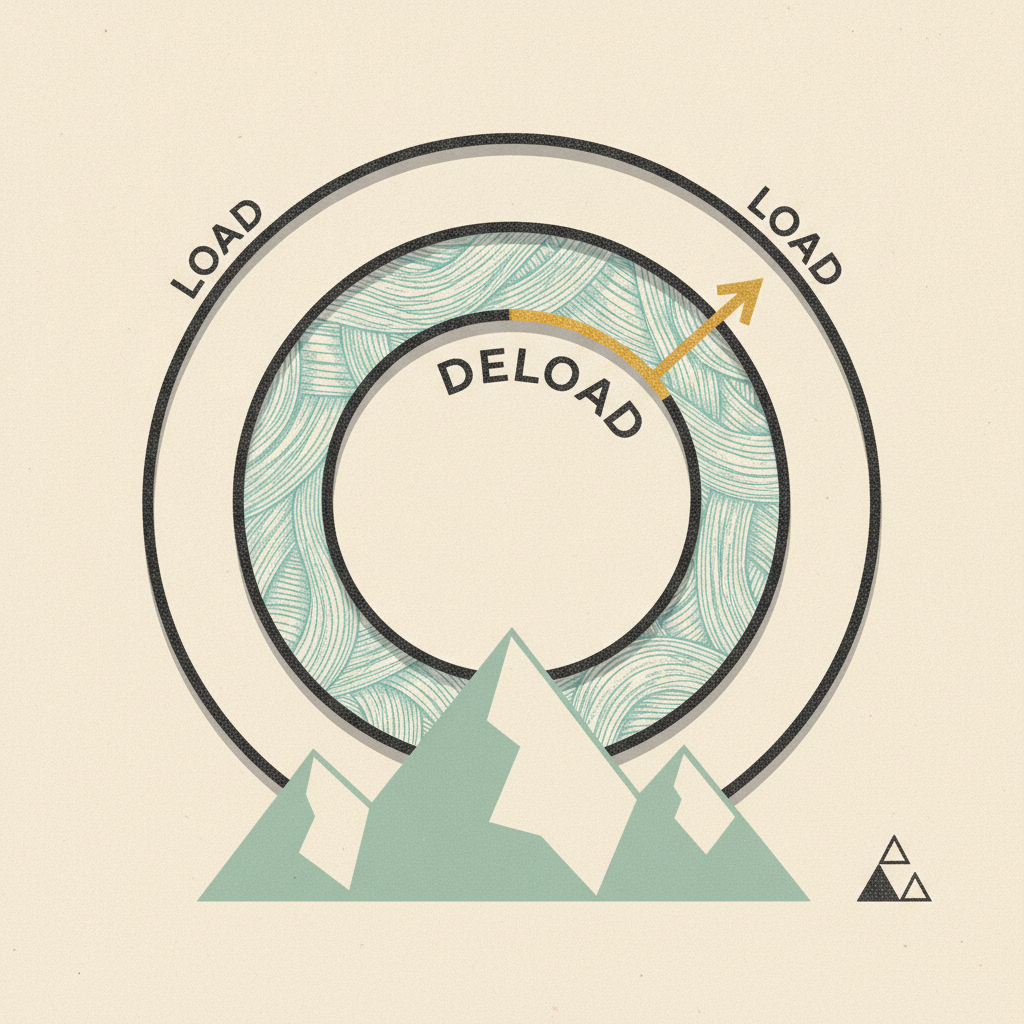
Given the physiological realities of masters athletes, a proactive approach to recovery is essential. This is where the 2-weeks-on, 1-week-off deload cycle shines. By building in a deload every third week, you provide your connective tissues, joints, and nervous system with the consistent breaks they need to fully recover and adapt.
Consider this comparison:
| Age Group | Typical Load Cycle | Masters (50+) Recommended Cycle |
|---|---|---|
| Under 30 | 3-4 Weeks On | N/A |
| 30-49 | 3 Weeks On | 2-3 Weeks On |
| 50+ | 2 Weeks On | 2 Weeks On |
Ascend's Deload Trail: Your Personal Recovery Compass
At Ascend Fitness, we understand that individual recovery needs can vary, even within the masters category. That's why our gamified fitness app goes beyond generic advice. Leveraging principles espoused by recovery experts like Christian Thibaudeau (often referencing the late Charles Poliquin and his ideas on recovery) and strength coaches like Jim Wendler (known for his 5/3/1 deload approach), Ascend's 'Deload Trail' feature is designed to auto-detect when you need a break.
How does it work? Ascend monitors key metrics to identify trends that signal accumulated fatigue:
* RPE Drift: Your Rate of Perceived Exertion (RPE) for a given weight and rep scheme should ideally remain consistent or improve over a training block. If your RPE for a specific lift starts to drift upwards – meaning the same effort feels harder than it did previously – it's a strong indicator of accumulated fatigue. Ascend logs your RPE after every set and analyzes this trend. * HRV Trend: Heart Rate Variability (HRV) is a powerful indicator of your autonomic nervous system's recovery status. A consistent downward trend in your daily HRV scores suggests that your body is struggling to recover and adapt to training stress. Ascend integrates with popular HRV trackers to provide you with insights into your systemic recovery.
When Ascend detects significant RPE drift combined with a downward HRV trend, it intelligently suggests initiating a deload week. This proactive approach helps you avoid overtraining, prevent injuries, and ensure you're always ready to conquer the next ascent on your fitness journey.
Why You Can't Afford to Skip (or Delay) Deloads
Skipping deloads as a masters athlete isn't brave; it's detrimental. It leads to chronic fatigue, increases your risk of tendonitis, strains, and tears, and ultimately sabotages your long-term progress. You'll hit plateaus sooner, feel constantly drained, and lose the enjoyment of training.
Embrace the deload. See it not as a step back, but as an essential two steps forward. It's the intelligent way to ensure longevity in your training, continue building strength, and keep reaching new peaks on your Ascend Fitness mountain. Your body will thank you, and your gains will prove it.
Ready to train smarter, not just harder? Discover how Ascend Fitness can tailor your journey to your unique recovery needs. Join the waitlist and start your ascent today.
Sam Wilson
Solo founder of Ascend Fitness. Building a gamified fitness tracker in Auckland, NZ. Lifts, runs, writes about both.
Ready to start climbing?
Beta climbers get TestFlight access, 14-day Ascend Club free trial, and a permanent founder discount on annual.
Join the waitlist