Creatine monohydrate: the most-studied supplement in fitness, explained
Creatine is the rare supplement with decades of high-quality research behind it. Here's how it works, who benefits, what to take, and what's hype.
In this article
# Creatine monohydrate: the most-studied supplement in fitness
Creatine monohydrate is, by a wide margin, the most-researched supplement in sports nutrition. Over 1,000 peer-reviewed studies. Forty years of data. The International Society of Sports Nutrition published a position statement in 2017 (updated 2021) calling it "the most effective ergogenic nutritional supplement currently available".
Despite that, creatine still gets confused with steroids, blamed for kidney problems, and avoided by people who would benefit from it. This post lays out the actual evidence.
What creatine is
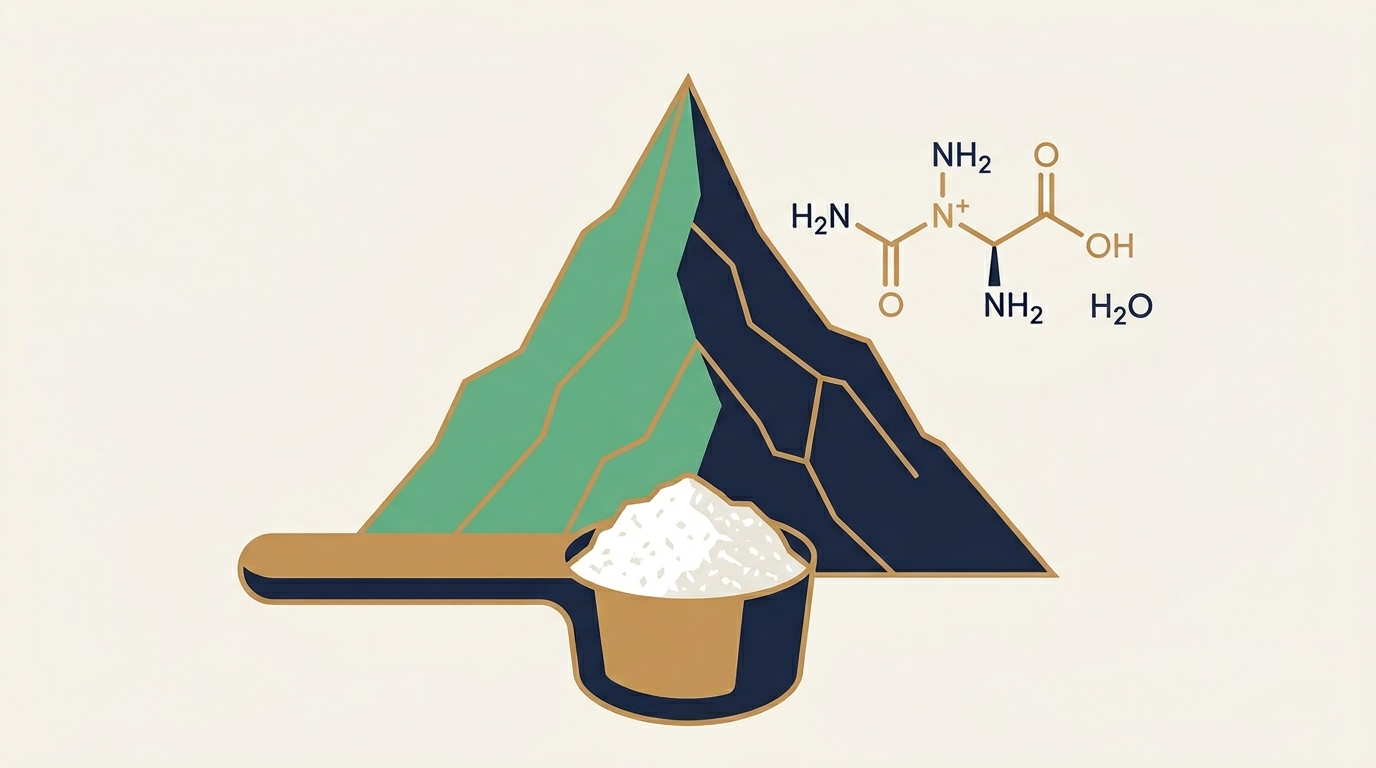
Creatine is a compound your body already makes from three amino acids (glycine, arginine, methionine). It's stored mainly in skeletal muscle as phosphocreatine, where it helps regenerate ATP — the energy currency of short, explosive efforts. Lifting a heavy set, sprinting, jumping. Anything under about 30 seconds at maximal effort relies heavily on this system.
Your body produces about 1g/day on its own. You also get some from meat and fish (about 1g per 250g of beef). Supplementation simply tops up the storage tank to its natural ceiling.
What the research shows
A representative meta-analysis (Branch, 2003, since replicated many times): creatine supplementation increases strength and power output by an average of 5–15% over placebo in resistance-trained athletes. The effect is consistent across sex, age (including over-60s), and training experience.
Other well-supported benefits:
- Lean mass gains of 0.5–2kg over 4–12 weeks (a mix of actual muscle and intracellular water)
- Improved high-intensity repeat performance (think team sports, HIIT)
- Cognitive benefits in sleep-deprived states and in vegetarians who naturally have lower stores
- Possible bone density support in older adults when combined with resistance training
What it does *not* do
- It is not a steroid; it's a naturally occurring compound
- It does not damage healthy kidneys (multiple long-term studies confirm safety up to 5+ years)
- It does not cause cramping or dehydration (myth from a 1990s NCAA report later retracted)
- It does not need a loading phase to work
How to take it
The simplest evidence-based protocol:
- 3–5g per day of creatine monohydrate, every day
- No loading phase needed unless you want full saturation in 5–7 days instead of 3–4 weeks
- Timing doesn't matter much (with a meal is slightly better for absorption)
- No cycling needed — there's no diminishing return or tolerance
Who should consider it
- Anyone doing resistance training
- Anyone doing high-intensity intermittent sport
- Vegetarians and vegans (naturally lower baseline stores → bigger effect)
- Adults over 50 looking to preserve muscle and possibly bone density
- People with chronic sleep deprivation (cognitive benefit)
Who should check first
- People with pre-existing kidney disease (rare contraindication)
- Anyone on prescription medications that stress the kidneys
- Pregnant or breastfeeding (insufficient data — better safe than sorry)
How Ascend treats supplements
Ascend doesn't sell supplements and isn't paid by any brand to recommend them. The app's nutrition section flags creatine as one of three supplements with genuinely strong evidence (the others being whey protein and vitamin D for deficient populations). Everything else is filed under "optional, not necessary".
Join the waitlist — evidence-based fitness, no supplement upsells.
Sam Wilson
Solo founder of Ascend Fitness. Building a gamified fitness tracker in Auckland, NZ. Lifts, runs, writes about both.
Ready to start climbing?
Beta climbers get TestFlight access, 14-day Ascend Club free trial, and a permanent founder discount on annual.
Join the waitlist